
Birth of Emoji: What Botticelli Taught Me
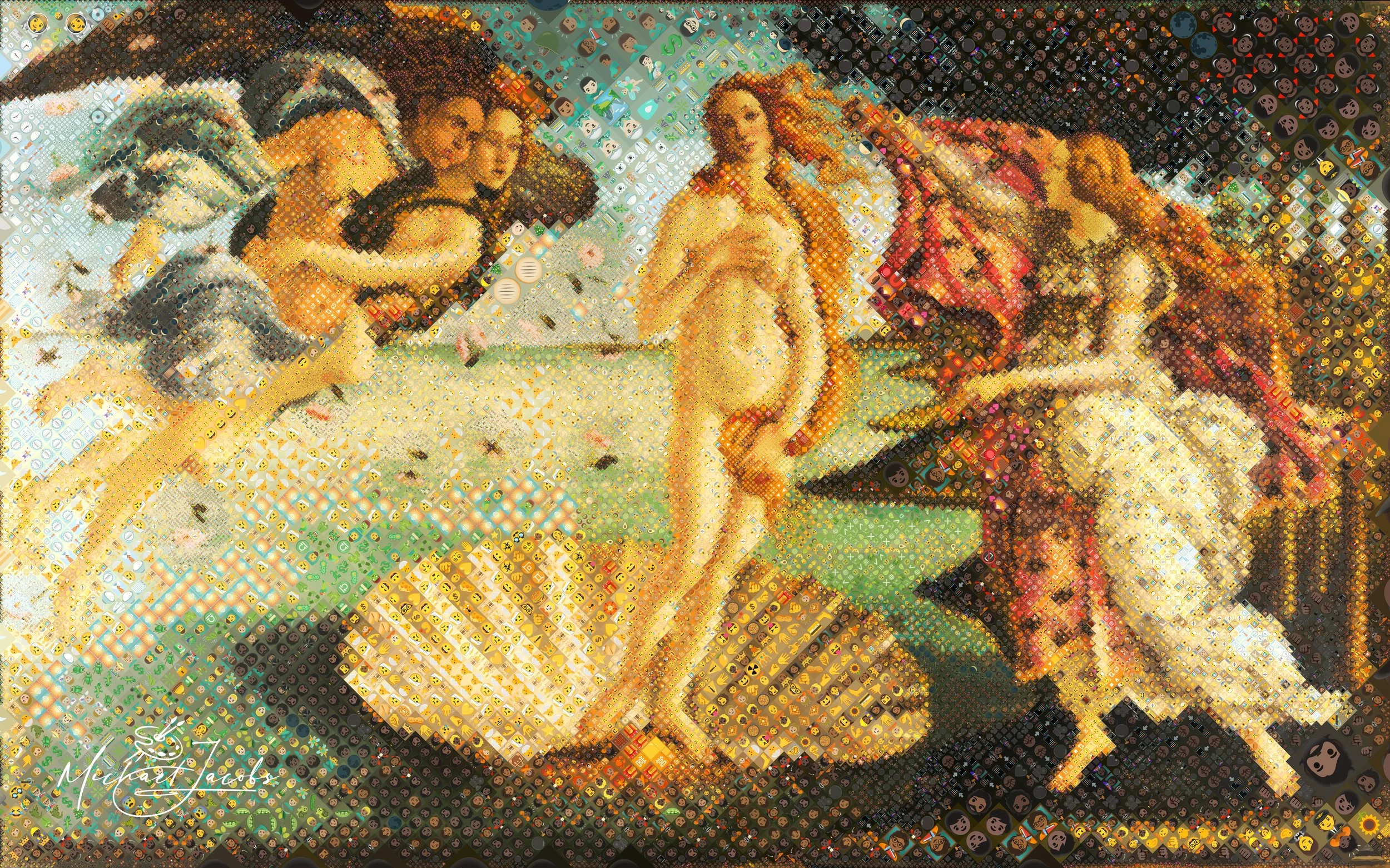
Every Diamoji I've made has taught me something new. A Great Wave of Emoji was about structure and motion. A Starry Night of Emoji was about color and energy. Birth of Venus was about something harder to pin down: precision.
The painting itself presented new challenges from the start.
Botticelli painted Venus with a soft, hazy quality that art historians call sfumato. Edges dissolve rather than define. The color palette is warm and subtle — creams, pinks, coral, and muted sage. There are no sharp transitions to anchor the system. Every prior Diamoji I made featured subject matter with strong structure: crashing waves, swirling night sky, a face with unmistakable geometry. Venus offered none of that.
The background added another layer of difficulty. A large portion of the canvas is open sky and water. These areas produce enormous tiles with relatively simple color. They carry enormous weight in the statistics I use to calibrate the piece. Getting the detail tiles right while those background tiles dominated every calculation took real work.
This project required more artist regions than any Diamoji to date.
Artist regions are how I direct the system's attention. I draw them by hand in Photoshop — bounding shapes around each figure, each area of the composition that needs to be handled differently. More regions means more control. It also means more decisions.
Birth of Venus has 31 artist regions. The figures alone account for most of them: Venus herself, the Hora figure on the right, Zephyr and Aura on the left, individual faces, hands, the shell at her feet, the flower-scattered shoreline. Each figure required its own region, sometimes more than one, to get the tile density right across the composition.
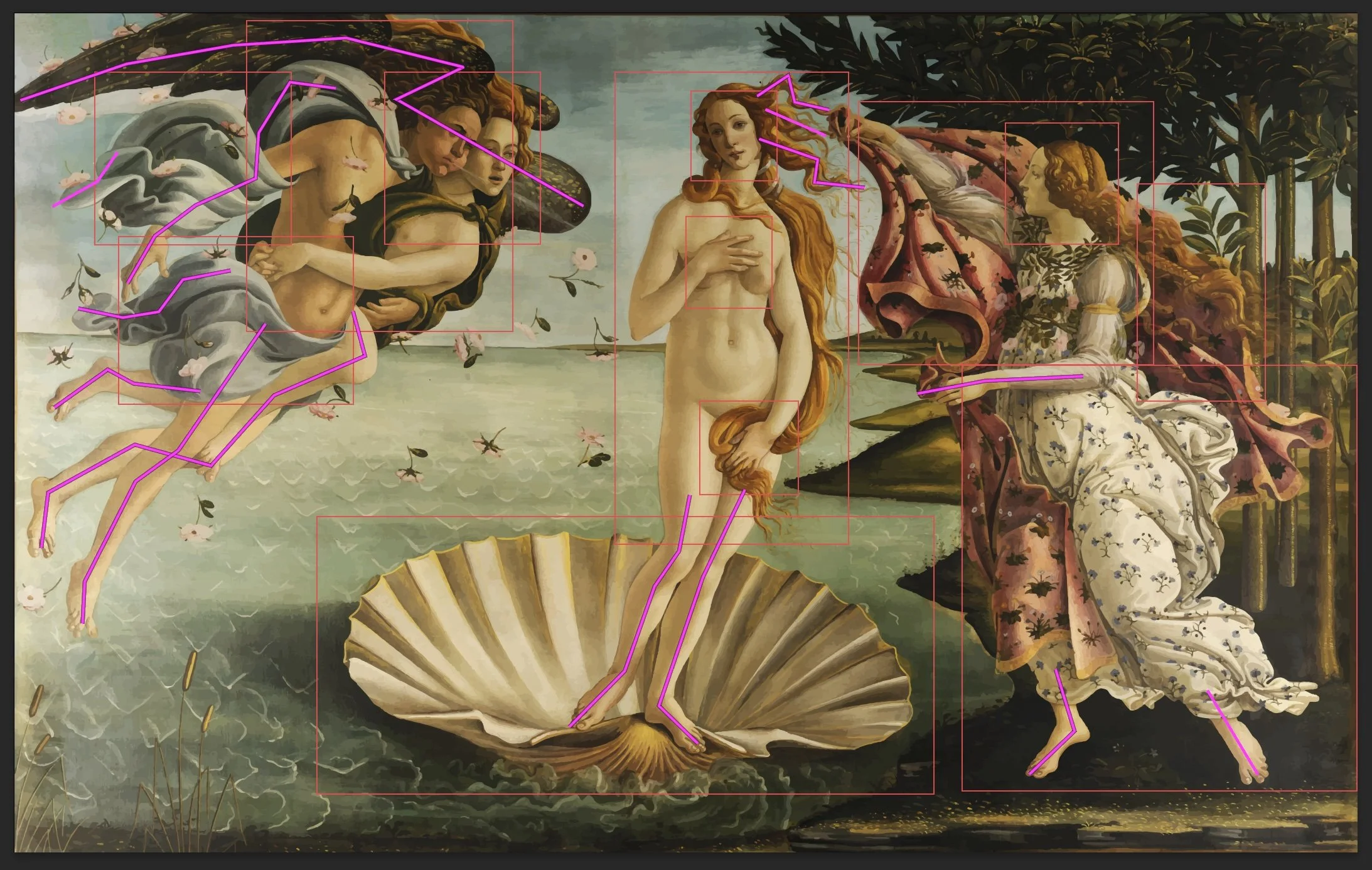
Artist regions designate where details are needed. The regions start as red rectangles and magenta line segments in Photoshop. The geometries are exported and fed into the rendering pipeline along with my additional settings about their reach and level of detail.
Birth of Venus was the first Diamoji to go through full color calibration.
Color in Diamojism is measured in LAB — a color space designed to match how human eyes perceive brightness and hue, rather than how screens produce them. After a major render, I analyze how closely the emoji layer matches the source painting across the entire LAB spectrum. When the numbers show a systematic bias — the output running too warm, too bright, too flat — I can compute a correction and apply it before the next render.
For Birth of Emoji, I needed one pass of calibration to bring the emoji palette into alignment with the painting's warm, skin-tone-heavy middle range. A second pass would have overcorrected. I could see it in the data: the numbers that had been slightly too high flipped negative, which meant the system had gone too far in the other direction.
Knowing when to stop is part of the craft.